
Maryland Felony Records
Maryland felony records are public court documents that show criminal case filings, charges, and outcomes for felony-level offenses across the state. The Maryland Judiciary Case Search is the main public tool for finding these records online. You can search by name or case number to find felony cases filed in Circuit Courts across all 23 counties and Baltimore City. This guide covers where to search Maryland felony records, what those records contain, how to get copies, and what the law says about access.
Maryland Felony Records Overview
Maryland Judiciary Case Search
The Maryland Judiciary Case Search at casesearch.courts.state.md.us is the official free public portal for Maryland felony records. It covers all court levels: District Court, Circuit Court, Court of Special Appeals, and the Court of Appeals. Felony criminal cases are handled at the Circuit Court level. This is where you will find the bulk of Maryland felony records online.
The system was redesigned on February 5, 2024, for the first time since its original January 2006 launch. The new version has a cleaner layout with condensed search fields. The most-used options load first. You can expand advanced filters as needed. The same underlying data and access rules apply as before. The redesign was driven by Maryland Rules 16-901 through 16-912, which govern public access to court records.
To search Maryland felony records, go to the site, read the disclaimer, and click "I Agree" to proceed. You can search by person name, company name, or case number. For a name search, enter the last name at minimum. The system uses "%" as a wildcard at the end of names. So "Smith%" would find Smith, Smithson, and similar names. You can then filter by court system, case type, and filing date range. Criminal cases include both felonies and misdemeanors. Select "Circuit Court" and "Criminal" to narrow results to Maryland felony records specifically.
Results cap at 500 records per search. If a search returns too many hits, add the first name or a date range to cut the list down. Each result shows the case number, court location, filing date, party names, and case status. Click any case number to see full charge details, hearing history, and sentence information. The system updates nightly, so very recent filings may not appear right away.
Note: The Case Search official disclaimer states the data should not be used to perform background checks on individuals.
What Maryland Felony Records Contain
Maryland felony records in the Case Search system include detailed case and charge information. When you open a felony case, you will see the defendant's name, city and state, and date of birth. Charge information lists each count with the statute citation, offense date, plea entered, and final disposition. Dispositions may show guilty, not guilty, nolle prosequi (dropped by prosecutor), stet (inactive), probation before judgment (PBJ), or dismissed.
Court events show every hearing with the date, hearing type, result, judge assigned, and courtroom. Financial information covers fines, court costs, and payment status. Some cases also show sentence details including jail time, probation terms, and fines. This level of detail makes Maryland felony records a useful public resource for learning about criminal case outcomes in any county.
Not all records are visible in the public search. Sealed records, expunged records, juvenile records, and certain shielded information do not appear. Recent law changes have also removed some categories from public view. Nolle prosequi charges, stet charges, and certain cannabis-related charges no longer show in Case Search results. If you cannot find a known case, it may be sealed, expunged, or in federal court rather than state court.
MDEC Electronic Courts Portal
The Maryland Electronic Courts (MDEC) system handles e-filing and document access for Maryland courts. The public portal at mdecportal.courts.state.md.us lets parties to a case view and download filed documents. This includes motions, orders, judgments, and other court papers from felony cases. You must be a party or attorney of record to access documents through MDEC.
To use the MDEC portal, navigate to the site and search by case number or party name. Only your own cases appear. From the case screen, click the "Documents" tab to see all filed papers. Each document has a "View Document" button that opens a PDF. You can also download files directly. Self-represented parties must register for an account and get approved for each case before they can view documents.
The Maryland Attorney General's office also provides a public MDEC document viewing entry point at marylandattorneygeneral.gov/mdec/efilingpublic. This is useful if you know your case is in the MDEC system but want a second path to access it.
Maryland Court Structure for Felony Cases
Maryland has two main trial court levels: District Court and Circuit Court. Felonies are handled at the Circuit Court level. Maryland has 24 Circuit Courts, one for each of the 23 counties and one for Baltimore City. The Circuit Court has jurisdiction over all felony criminal cases. It also handles major civil matters, family law, and juvenile cases. You can find a full directory of all Maryland Circuit Courts at courts.state.md.us/circuit/index.html.

District Court handles misdemeanors, traffic cases, and civil matters under $30,000. Felony cases that start in District Court as preliminary hearings are transferred to Circuit Court for trial. The District Court directory is at courts.state.md.us/district/index.html. Records from both court levels appear in the Maryland Judiciary Case Search.

Circuit Court case numbers follow a specific format: county code, case type letter, two-digit year, and a sequential number. For example, a case filed in 2024 in Montgomery County might appear as "C-15-CR-24-001234." The county code number identifies which of the 24 jurisdictions filed the case. When searching for Maryland felony records by case number, you need the full case number in this format.
Maryland Felony Records Laws
Maryland law governs who can access felony records, how long records stay public, and when records can be removed. These rules come from the Maryland Code and the Maryland Rules that govern court procedures. Understanding the basics helps you know what to expect when searching Maryland felony records.
Under Maryland Code, Criminal Procedure Article § 10-101, "criminal history records information" is defined broadly to include arrests, charges, dispositions, and corrections data. Section 10-105 sets restrictions on who can get this information and imposes penalties for misuse. Section 10-109 gives individuals the right to challenge inaccurate records in their own criminal history. If you believe your Maryland felony record contains errors, you can submit a written notice to the court where the record was created.
The Maryland Public Information Act (MPIA), found at General Provisions Article §§ 4-101 through 4-601, is the main open-records law for Maryland. It gives any person the right to inspect public records during regular office hours. Courts and police departments must respond to requests within 30 days. The first two hours of search time are free. Copies cost $0.50 per page as a standard rate. If a request is denied, the agency must cite a specific statutory exemption in writing. You can learn more about your MPIA rights at marylandattorneygeneral.gov/Pages/PIA/index.aspx.
Court records access is specifically governed by Maryland Rules 16-901 through 16-912. Rule 16-907 lists the records that are not open to the public, including adoption records, juvenile records, mental health records, and certain family law materials. Felony criminal case records are generally public under these rules unless the court has issued a sealing order.
Senate Bill 432, passed in the 2024 session and effective October 1, 2025, expanded the list of offenses eligible for expungement in Maryland. New additions include driving without a license under TA 16-101, credit card theft under CR 8-206, and bad checks under $500 under CR 8-103. The bill also removed the old rule that probation violations barred expungement. This means more people with Maryland felony records may be eligible to seek expungement going forward.
CJIS Criminal Background Checks in Maryland
The CJIS Central Repository is the only source for official statewide criminal history background checks in Maryland. It is maintained by the Maryland Department of Public Safety and Correctional Services (DPSCS). If you need a complete and certified record of all Maryland felony records for a person, CJIS is the right source, not the public Case Search.
To request your own criminal history from CJIS, you need fingerprints, a completed application form, a photo ID, and a $38 fee. Electronic fingerprinting (Live Scan) is the fastest method. Results come back in 10 to 15 business days by mail. Paper fingerprint requests take 4 to 6 weeks. The CJIS Central Repository is located at 6776 Reisterstown Road, Baltimore, MD 21215. You can also mail requests to P.O. Box 32708, Pikesville, MD 21282-2708. Call (410) 764-4501 for information. Hours are Monday through Friday, 8:00 AM to 5:00 PM.
Authorized agencies can also request background checks through CJIS for specific purposes using ORAF (Office of Repository Administration Form) types. The ORAF 1 is for general use, ORAF 2 covers health occupations, ORAF 3 is for child care, and other forms exist for security, firearms, gaming, and financial institutions. Fees range from $18 to $38 depending on the ORAF type. The DPSCS website at dpscs.state.md.us has additional information about inmate location and corrections records.
How to Request Maryland Felony Records
You can request Maryland felony records in several ways. The easiest is through the free online Case Search. For certified copies or documents not in the online system, you need to contact the Circuit Clerk in the county where the case was filed. Most clerks accept in-person, mail, and sometimes email requests. Standard copies cost $0.50 per page. Certified copies cost $5.00 plus $0.50 per page.

For police incident and arrest records related to a Maryland felony case, you submit a request to the police department or sheriff's office that made the arrest. Most agencies require a written request with the report number, incident date, location, and your ID. Each agency sets its own fees. Baltimore City Police charges $10 per report. Anne Arundel County Police charges $5 for recent reports and $35 for archived ones. Montgomery County Police charges $10 per report. These are separate from court records and must be requested from the law enforcement agency directly.
If an agency denies your MPIA request, they must cite the specific legal exemption in writing. You can contact the Public Access Ombudsman in the Attorney General's office at (410) 576-7043 or email publicaccess@oag.state.md.us for help resolving disputes without going to court. The Ombudsman can mediate disagreements and issue advisory opinions, though they cannot force an agency to release records.
Maryland State Police Records
The Maryland State Police (MSP) maintains its own Central Records Division. This office holds records from MSP investigations and arrests. If a Maryland felony case involved the State Police rather than a local agency, MSP is where you get the police records. The Central Records Division can be reached at (410) 281-2700. The main MSP website is at mdsp.maryland.gov.
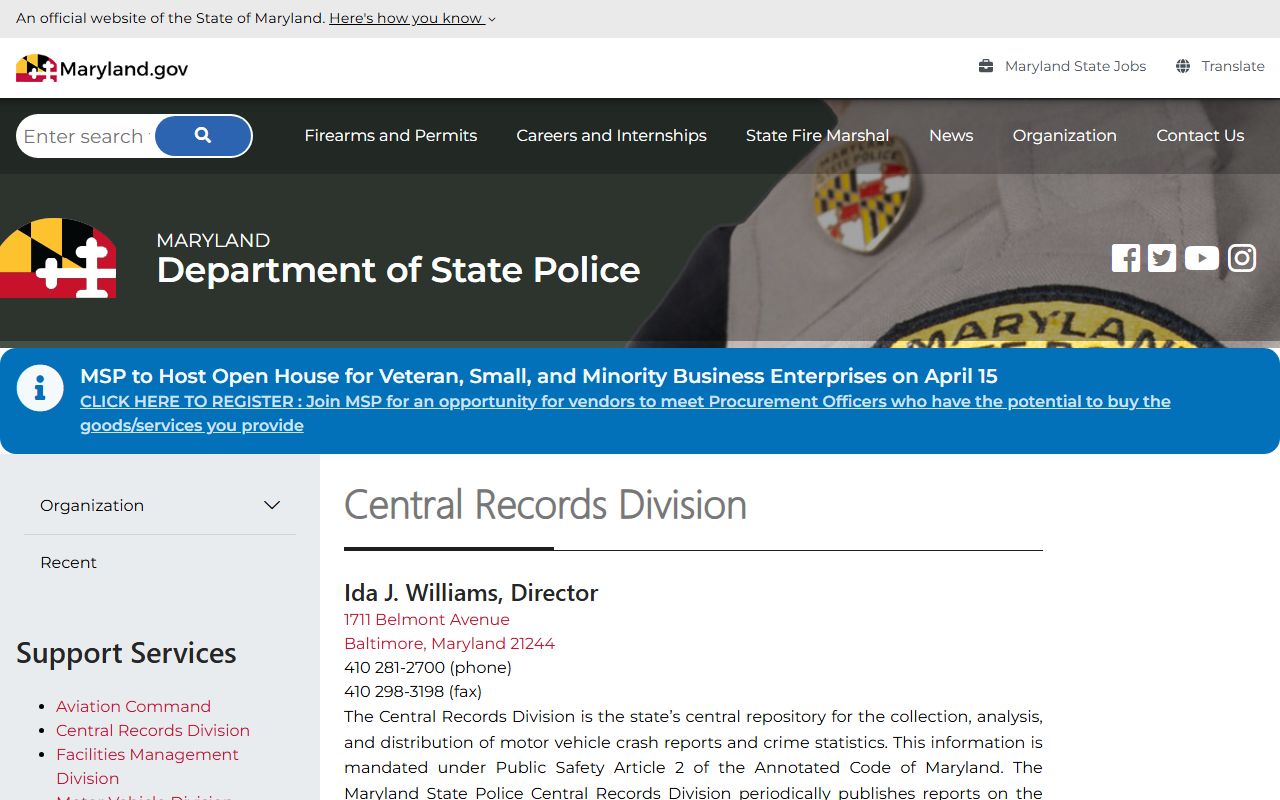
MSP Central Records is located at 1201 Reisterstown Road, Pikesville, MD 21208. Requests follow the MPIA process. Submit a written request describing the record you need with as much detail as possible. Include your contact information, preferred format, and the maximum fee you are willing to pay. MSP must respond within 30 days under the MPIA. If your request covers records from multiple MSP investigations, expect a longer processing time. The MSP Central Records Division page has current contact and request information.
Expungement of Maryland Felony Records
Expungement removes a criminal record from public view. Under Maryland Code, Criminal Procedure Article §§ 10-300 through 10-306, a person can petition the court where their case was heard to have records destroyed or sealed. Not all Maryland felony records are eligible. The 15-year waiting period applies to most felony convictions. The clock starts after you complete your sentence, including any probation or parole.
The petition process requires filing form CC-DC-CR-072 (Petition for Expungement) at the sentencing court. You must also submit form CC-DC-CR-073 (General Waiver and Release) at the same time. The filing fee is $30 per case, though the court may waive this fee if you qualify. Once the court enters an expungement order using form CC-DC-CR-074, it is served on all agencies that hold the record. Those agencies must comply and destroy or seal the records. Expunged Maryland felony records no longer appear in the public Case Search.
Senate Bill 432 (2024) and House Bill 36 (2025) made major changes to Maryland expungement law. More offenses are now eligible. Waiting periods for some offenses were reduced. Probation violations no longer block expungement. If you have an older Maryland felony record, it may now qualify under the new rules effective October 1, 2025.
Note: For detailed expungement eligibility questions, contact a Maryland attorney or visit a local legal aid office.
Search Maryland Felony Records by County
Each county in Maryland has its own Circuit Court that keeps felony records. Pick a county below to find local courthouse details, contact info, and search resources for that area.
Maryland Felony Records by City
Residents of major Maryland cities file felony cases at their county Circuit Court. Pick a city below for local felony records resources and courthouse information.